origin stories conflict
2016 · creation & evolution
The prevailing weapons and strategies used in the creation vs evolution conflict are doomed to failure. This book has the answer — not by convincing you which story is true, but through an understanding of how language, reason, trust, and arrogance contribute to the conflict.
Introduction
We human creatures are masters of the earth with power unmatched by any other living thing. We reorder the biosphere to our liking. We cut down the great giants rooted in the earth for their woody parts. Endless plains of green plants grow in obedient rows waiting to be harvested as our food. The beasts of the land are displaced as we expand.
We have transformed the earths materials; brought up mammoth volumes of gas and coal from the underworld to fuel our machines and ambitions. Our muscles are hydraulics, gasoline, and dynamite. We operate mechanical monsters to dig, gather, and move the earth.
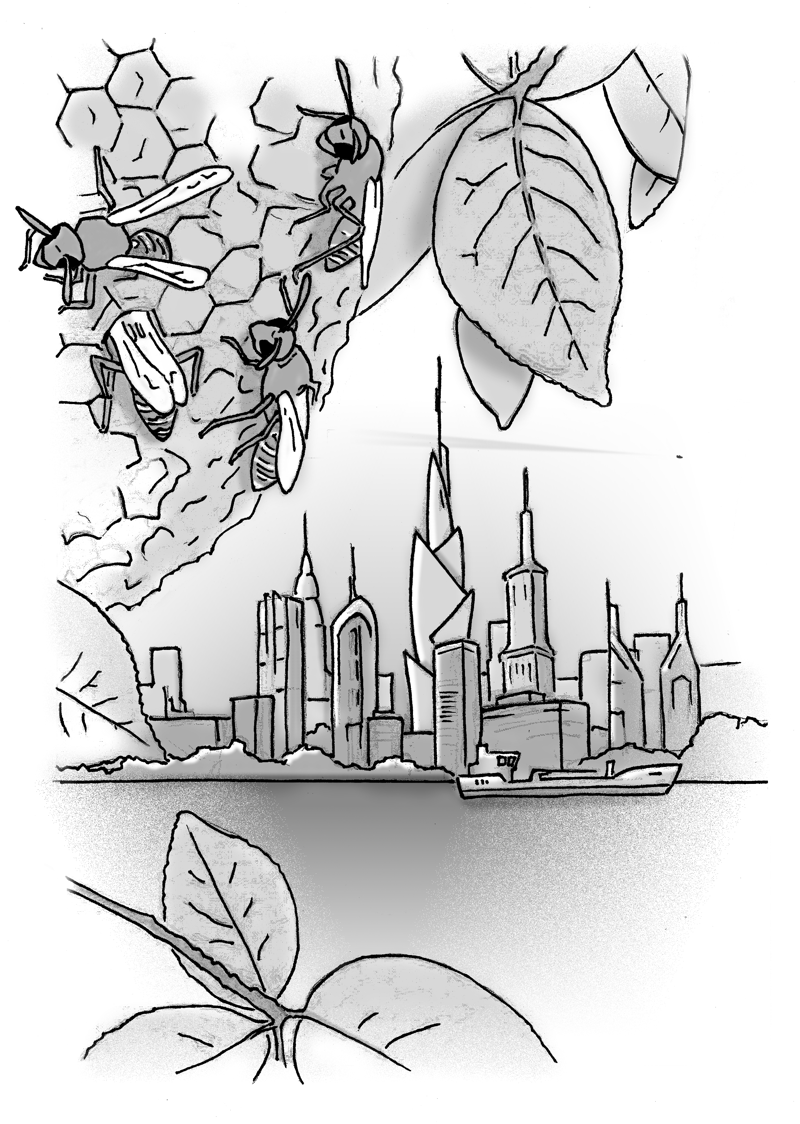
Our shelters are unlike those of the bees, ants, or beavers. Great towers of concrete, glass, and steel reach up into the clouds. The most precious and necessary resource to all life conveniently flows through pipe networks to porcelain basins throughout all our buildings. We generate electrical power with large turbines and route it through copper wire, powering motors, pumps and fans giving us heating, cooling and illumination when the sun goes down.
We can blast through the atmosphere faster than sound or can go to the bottom of the deep ocean or out to the lights in the heavens. Though we are spread out over the whole world, we are all intimately connected by our manipulation of light, electricity and electromagnetic waves.
We have incredible control over so many aspects of our environment. Most are now far removed from any need for simple survival skills. We do not need to worry about finding food to avoid starvation or finding shelter or warmth, as is the constant struggle for all other creatures. We are entirely divorced from the eat or be eaten cruelty of nature. Even though we are small, soft, and delicate compared to some, we are the masters of the Earth, with the ability to destroy all its life, and for many, a sense of duty to preserve it.
Not only do humans possess a power and knowledge of this world which allows us to manipulate, control, and transform it, but many think they possess even greater powers than this. It is thought by many that we can know of other places and times which our eyes have not seen; even the origins of all life and the universe.
ORIGIN STORIES
There are two popular origin stories which are the subject of much debate and conflict; creation and evolution.
In the story evolution
the natural laws of the universe caused matter to coalesce into galaxies, stars, planets and eventually living things over a very long time.
Life began on our planet as a simple tiny replicating combination of molecules which evolved in complexity with each successive generation over millions of years.
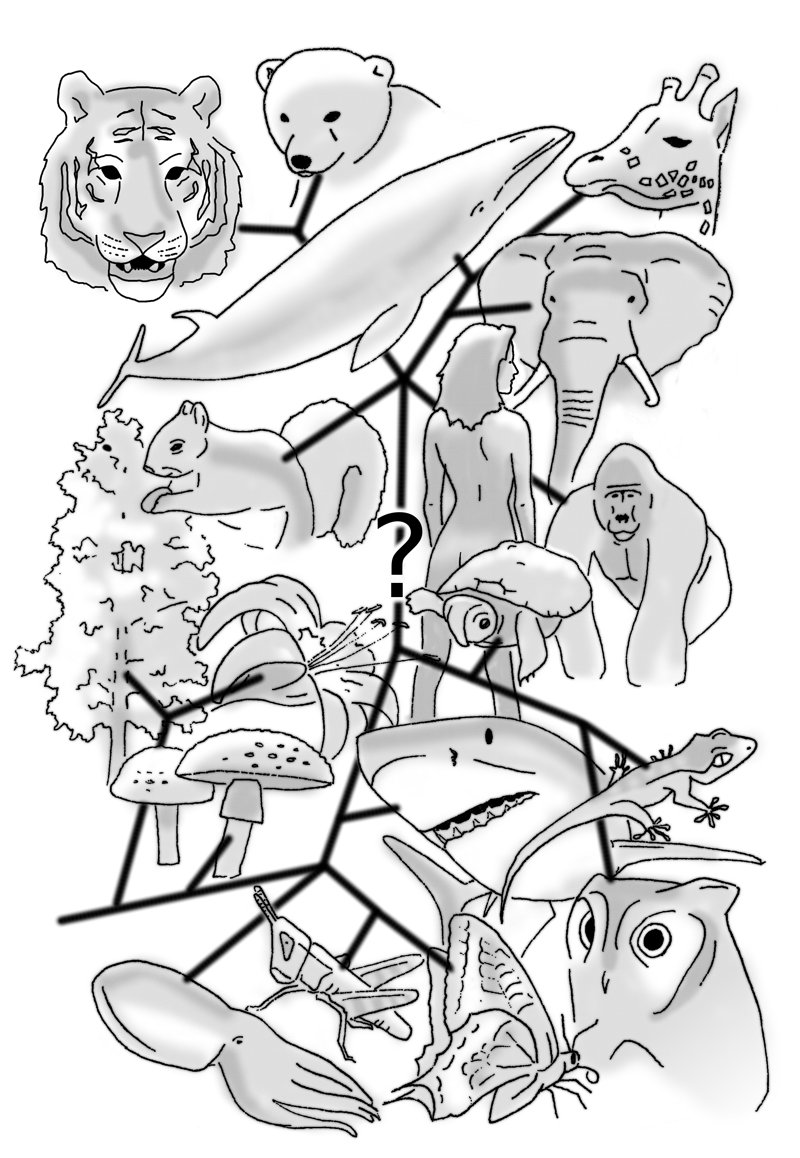
Human beings are descendants of fish like creatures. Mushrooms, snails, and trees are our distant relatives.
In the story of creation
God caused the land, water, sky and lights to form quickly. The world was then immediately filled with many different kinds of creatures; birds, fish, creeping things, beasts, and humans.
From the first week, every kind of living thing was fully formed much as it is today. The very first living creature was as complex as those living today with the built in ability to change.
We have no relation to any creature other than human.
Each of these stories has a large number of believers and there is significant conflict between them. People regularly and passionately fight over whether we come from a preexistent God or natural laws of the universe. Angry words are exchanged in vanity as people struggle over which story is true, over which story should be taught in public schools, and which should receive government support and money. Heads clash in United States court rooms and on school boards.
In my experience most people on both sides are so confident in their story, that the other is to them not only wrong, but absurd or stupid. Lacking absolutely no confidence, many try to impose their story on others. They even feel a sense of duty to correct others.
People from both sides have organized into groups to more effectively wage battle. They travel to schools and churches to persuade, strengthen or correct audiences. Endless ammunition in the form of books and magazines have been manufactured to win the war. The conflict is spread out all over the world wide web, in movies, message boards, and mass archives of rhetoric, evidence and proof. Pastors preach on how evolution is impossible from their pulpit, while other teachers explain creationists are ignorant from their classrooms.
The laws of our country spread and protect the evolution story while suppressing the creation story. This enrages creationists. Take a look at some of court case victories boasted of on the National Center for Science Education (NCSE) website: [Matsumura 2001]
- The teaching of evolution cannot be prohibited.
- A "balanced treatment" may not be provided to both stories.
- The teaching of creation is prohibited in public schools.
- Evolution “Disclaimers” to promote "critical thinking" are unconstitutional.
"Evolution should not be misrepresented as 'controversial' or in need of 'critical analysis' or special attention for any supposed 'strength or weakness' any more than other scientific ideas are." [NABT 2011]
Some evolution believers are now organizing to stop state money from going to fund private Christian schools which teach the story of creation.
“Charter schools that are perceived to be promoting or endorsing religion in their schools may be accused of violating the Establishment Clause.” [Crothers 2014]
If we human beings do indeed have the power to know of our origin, shouldn't we be able to agree on something? If there is really proof of a story why can't it be successfully shared? How can there be so many people who are so confident in contradictory stories? A great many of them must be wrong.
This book will show why this conflict exists, why we can't agree, and what we can do to fix it and get along.
Language
Language is the source of our human power. Words - spoken, written on paper, transmitted across wires, or through space - enable humans to work together. Through the division of labor and knowledge, mankind as a whole possesses incredible power.
Our steel towers require the cooperation and communication of an entire civilization; people to collect and transform earth's raw materials into steel, wire, glass, or brick. Others to convert these into products such as light fixtures, bulbs, plywood, nails, screws, motors, carpet, and shingles. Others take these products and built up more complex products. Designers develop plans for them to all come together. Transporters bring them together by ship, truck or airplane. Tradesmen assemble; laying bricks, framing walls, or welding pipe. This is all possible because language enables all these people to work together.
While language is responsible for our great power, it is also the cause of much of the conflict over origin stories.
We clever creatures recognize connections between occurrences. We observe when a particular event always proceeds another. We speak of this first event as the “cause” of the following event, or “effect”. After building up a giant knowledge base of causes and effects we have the tools to manipulate our world.
Since cause and effect can be seen in every aspect of our lives, we naturally assume that the beginning of life and the universe had a cause as well. The two origin stories of creation and evolution speak of two different causes; “god” and “laws” respectively.
One man looks at the incredible complexity and beauty of the world and reasons that this could not have come from nothing! There must be a god who caused it and this is to them a satisfactory end. Then there are others - like Richard Dawkins - who see the god idea as a bigger problem rather than an answer.
So what did cause the universe: god or laws? After considering how language works, it seems like a silly thing to argue about, and it is easy to understand why people cannot agree and why there is conflict.
Language is built on a foundation of common experience. People have lots of experiences in common. They see the same colors, shapes, hear the same sounds, taste the same foods, feel the same pains and pleasures, and have similar life circumstances to a large extent. This common ground of shared experience is what makes communication possible through sounds and symbols, each representing a particular experience, observation, or feeling. The simplicity and power of language is clearly seen when watching a child learn to speak. A sound is associated with a concrete experience. “Cookie” associated with the taste of delicious chocolate. “Bath” with the joy of splashing water all over the place.
Words only have meaning when connected with some sort of sensual experience or feeling. So communication can only take place between two people who have had enough worldly experiences in common with which to color the words which they exchange.
It is not possible to persuade someone of something if the words exchanged are not fully defined to both people by similar earthly experiences. If a word is undefined there will only be confusion. If there are different definitions, then there will be argumentation.
Every argument, discussion, debate, every exchange of words requires the mutual acceptance of definitions.
The reason conflict over the earth's cause never ceases is because the two words are not defined with worldly experiences.
Why do objects fall? Why does heat move from a warmer temperature to colder? Why does a changing electric field produce a perpendicular magnetic field? Since we are so accustom to speaking of everything as if it has a cause, we go ahead and attribute these basic phenomena to something called “laws”. What is a law? There is not something called a law that you can see or feel. We cannot peer into the deep reaches of space to see some kind of cosmic law book or contraption which is the cause for our many phenomena like gravity. It is nothing more than an empty term used because we are accustom to speaking of every event as if it has a cause.
What is god? And how does god differ from a law? What can we point to that is god? As people attempt to define god they use many other earthly words. Common god synonyms include: creator, being, maker, and intelligent designer. These words have an ordinary and concrete meaning linked with experience with humans and human behavior here on earth, but these words are no longer being used to refer to those concrete experiences. Intelligent designer is a term defined by observation of the ingenuity and creative acts of a human being, but if it is no longer referring to that, to what is it referring? To define god one will move from one abstracted term to another.1
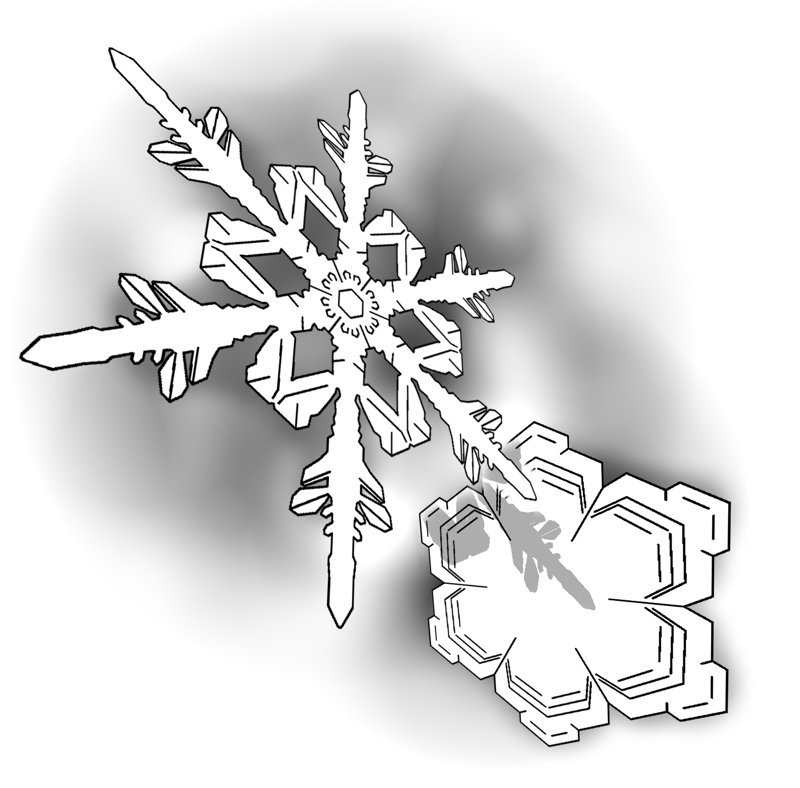
What if I said that the phenomenon of gravitational pull was actually caused by god, and not laws? What is the difference between the two? Is the delicate beauty of a snowflake structure a product of an "intelligent designer" or a "law"? You have no way to distinguish between them, no physical description based on sight, no smell, touch, texture, sound, nothing.
I must have heard a hundred people say that the world must have been caused by god, because it could not have come from nothing. But how can you say that “laws” are nothing if they cannot be defined?
Intelligent design promotes god over laws because they insist that the world appears to be designed. I would most certainly agree. We recognize the designed works of other humans, and many of the marvels in nature have the same quality of function, purpose, and beauty. But what does this mean? Did people design life? No. What did? A spectacular system of preexistent laws or a spectacular preexistent god. As we reflect on the beauty and awesomeness of the universe, finely tuned, on a razors edge, do we attribute our awe to incredible laws or awsome god? What would the difference be? They are just two different 3 letter words with no reference in the world.
I think the whole conflict over the cause of the universe is a large amount of conflict resulting solely from poor use of language and arrogance. It is a bunch of people exchanging heated statements with undefined words. Speaking only of the cause of the universe is doomed to failure. Cause is only meaningful insomuch as it is an event which proceeds another event. It is no wonder that a resolution is not found.
This is a conflict similar to two people yelling at each other in different languages. Only the words are familiar to both so they do not recognize the absurdity which is unfolding. It is ridiculous for any person to argue for something they cannot define or to be swollen with the confidence that their knowledge extends beyond the things of the world which they can experience with their body. Why do people think they have the ability to know of things beyond what their eyes, hands, and ears tell them? It is no surprise to me that those who do engage in this practice do so with inconsistent results.
Reason
The two origin stories, insofar as they describe events which occurred in the past, can be told using words which are defined with worldly experiences. So at least when people are arguing about their events they are using commonly defined words and are arguing about something that all can understand.
Did life show up on earth in a single week, or did life develop in form and complexity from very simple beginnings over a great period of time? Fast or slow? Over many generations or all in the first generation? Are we all related (common descent)? Did fish and humans show up together from the beginning, or did we develop from fish like creatures? Did the blueprints of all living creatures develop over time, or did the very first living creatures posses the same blueprints which are utilized by our bodies today?
Those who believe they have the power to know such things speak of mind powers such as logic and reason. They cite evidence and proof. If humankind really does have the power to know of our unseen past, why can't we all agree? Shouldn't such powerful creatures be able to come to a common understanding?
We have become accustom to being able to do so much with our reason and derive information from particularities2 of the earth beyond what is visible. Observing the workings of our environment, we become familiar with numerous causes and effects, one thing causes another thing, then we start to see greater meaning beyond things. When we see charred wood, we immediately know there was a fire, even though our eyes have not seen a flame which caused it.
An innumerable number of particularities have been cited as being evidence or proof of some sort to someone. Cited particularities include the appearance, composition, habits, variation, development, and distribution of living things, elemental compositions of the earths rocks, fossils, and even the celestial bodies, their movement, and much much more.
COMMON DESCENT
Charles Darwin spent a great deal of time investigating the particularities of the living world; affinities of creatures and their ability to change. He reasoned that most, if not all creatures, are related. Just as we humans have a family tree of those who are closely related to us by birth, all living things are related and can be fit into a great tree of life.
"In considering the Origin of Species, it is quite conceivable that a naturalist, reflecting on the mutual affinities of organic beings, on their embryological relations, their geographical distribution, geological succession, and other such facts, might come to the conclusion that each species had not been independently created, but had descended, like varieties, from other species." [Darwin 2008]
Darwin observed that life changes over generations. And people of his day discovered that they could make living things more suitable and desirable for their needs by “selecting” or preserving the best living things, and eliminating the undesirable. Crops and livestock can be refined and produce greater yields and a better product. He then reasoned that just like we are able to make living things more suited to our purposes, nature “selects” the most fit creatures in harsh environments and conditions. Working over a far greater time span than human selection, “natural selection” would be capable of so much more, even creating all the varieties on the earth today.
I'd like to quickly point out that far more incredible than the small changes which occur from generation to generation are those changes which occur within the life time of an organism. Life's ability to transform and change over time is spectacular.
Look at the life of an oak tree. The tinny living acorn transforms into something entirely different and bears absolutely no resemblance to its former self. It splits open and sends roots into the earth in search for water. Little green leaves and a stem reach up towards the sun. It builds up a woodly support structure with strong branches for thousands of delicate intricately shaped green sun harvesting factories. And then it creates thousands of the little acorns from which it came.
Living things transform light, water and dirt into potatoes, grapes, strawberries, and bananas. The caterpillar crawls along the trees eating leaves until it builds itself into a sack and transforms into a butterfly with beautiful wings covered in mosaics with all kinds of iridescent colors and patterns. A frog begins life swimming through a pond with a tail. It then grows legs, with little bones, muscles and tissues coordinated to allow it to crawl up onto land.
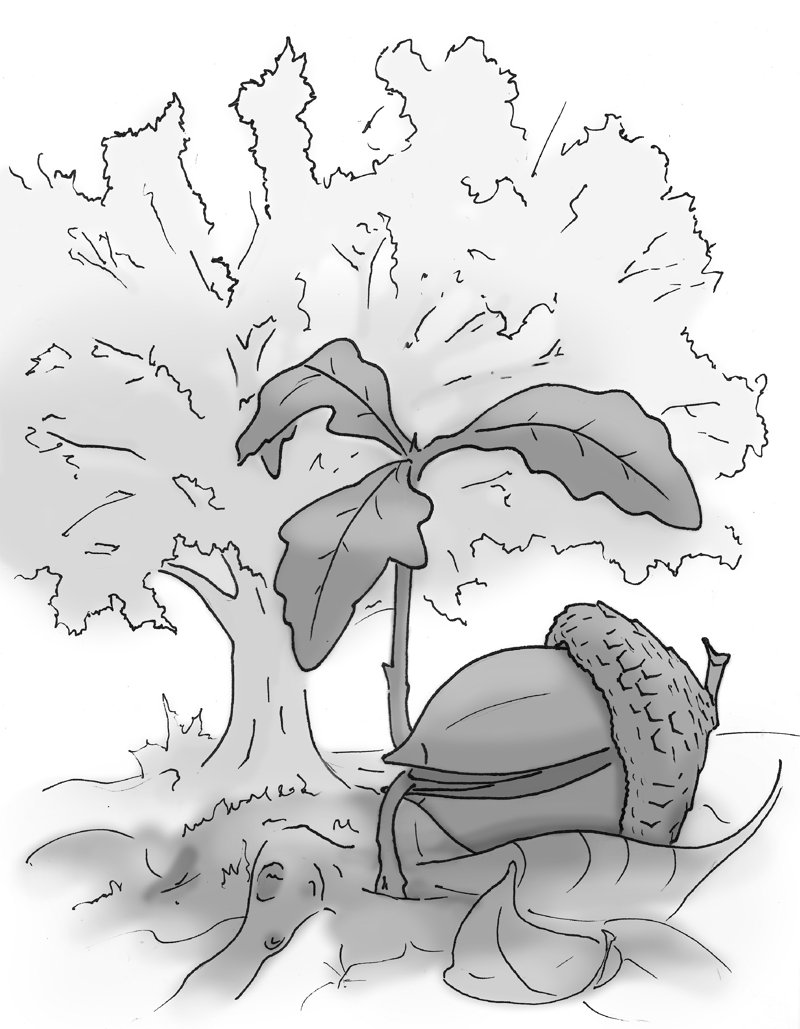
With life's extraordinary ability to change, it seems completely reasonable that apparently unrelated creatures could have changed over time and descended from a common ancestor.
Looking at all the particularities that Darwin cited in his Origin of Species his conclusions are not only reasonable, but observed alone with no modern knowledge, it is quite persuasive to me. We share features with our more recent ancestors. Those who are more different are more distant relatives. All land vertebrates have 4 limbs because they are more closely related.
BLUEPRINT DEVELOPMENT
However, I possess knowledge of many particularities which Darwin knew nothing about. When these are added to the picture things change dramatically.
Why do living things transform and change from generation to generation? Darwin attributed changes to the so called “mysterious laws of variation”. He observed that use, disuse and conditions of life seemed to play some kind of role, but ultimately admitted ignorance:
"Our ignorance of the laws of variation is profound. Not in one case out of a hundred can we pretend to assign any reason why this or that part differs, more or less, from the same part in the parents." [Darwin 2008] "Whatever the cause may be of each slight difference in the offspring from their parents - and a cause for each must exist - it is the steady accumulation, through natural selection, of such differences, when beneficial to the individual, that gives rise to all the more important modifications of structure, by which the innumerable beings on the face of this earth are enabled to struggle with each other, and the best adapted to survive." [Darwin 2008]
For us living today, new meaning has been given to the “mysterious laws” with new knowledge of genetic code, DNA, and molecular machines.
All living things are composed of cells, and these changes can be attributed to certain molecules protected in the center of every cell. This is described as information or the blueprint which tinny machinery reads to build up the creature.
These tiny cells, divide, multiply, work together and build up the incredibly diverse creatures to fill rain forests, deserts, grasslands, lakes, ponds, and oceans.
A single cell no larger than a period (.) contains all the instructions necessary for it duplicate into billions of copies, and work together with its copies to create structural supports, blood transportation arteries, electrical signal networks, and the brain from which our thoughts proceed.
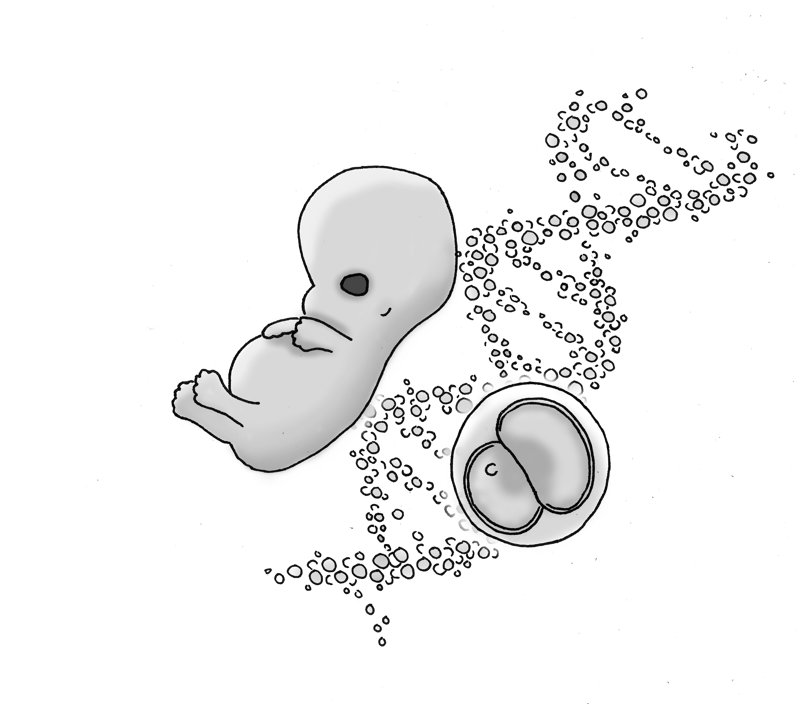
Multiple chambers, bone levers, and snail-shaped tubes with sensitive hairs sense motion and send signals through a nerve network in the brain enabling us to gather information from vibrations in the air. Cells monitor and adjust their own internal conditions, organelles move supplies, transport proteins, expel wastes and bring in resources.
Having observed life's extraordinary ability to change and the mechanism by which it accomplishes that change, it is still entirely believable that all things could be related to a single ancestor. If a program in a cell could turn a dot into a human being, an acorn into a massive tree, then it seems like anything could be possible. Even the thought of a mushroom transforming into a blue whale does not seem ridiculous; if such a program was written. Having witnessed the wonders of the natural world, its intriguing to imagine a single cell containing a super library of code which could enable it to ultimately transform into all the life forms existing today.
So the real question of life's origin for me becomes where did the blueprints of life come from? The evolution story says it developed in this world, and the creation story says it was fully formed at the beginning.
The code of life is not an arrangement inherent in the materials and laws of our universe, just as the written text on this paper cannot be explained by the chemistry of ink. The positions of the symbols transcends the medium. [Strobel 2004]
The “natural selection” which Darwin wrote of needs variations to select from. According to evolutionary story tellers today, the mysterious laws of variation are now primarily referred to as “random” changes to the code or “mutations”. They are considered changes to the blueprint, rather than changes produced by blueprints. It is believed that the complexity of all life exists because these small changes were built up over millions of years because they gave the organism a favorable advantage, and those which did not change would die. So nature selects and builds up better creatures over time.
This in light of modern knowledge this idea seems to me absurd in the highest degree. I expect that beneficial changes occur as directed by the code, and that random changes to the code, with a few very limited exceptions, will ultimately cause problems, disease, cancer and/or death.
One of my hobbies is computer programming. Making a computer do certain things can require complex code and careful thought. When writing code I often run the script after writing just a few lines of code to see if any errors occur. When the script fails I must go back and see what went wrong. Many times it can be from leaving out a single period, semicolon or dollar sign. The thought of making "random" changes to my code, and expecting a favorable mutation is absurd. A change ever so small will very likely kill a function or the entire thing.
Likening genetic code to software is common done. Efforts are underway to “re-program” bacteria and yeast to produce products they wouldn't normally make, such as fuels or drugs.
“To do with biology what you would do if you were designing a piece of software” [Sanders 2013] “begin to understand how life is written, how life is coded, how life is copied, and how you can rewrite life.” [Sanders 2013] “the future is in programming cells” [Sanders 2013]
One example of evolution by random mutation often cited is bacterial resistance to streptomycin. It seems far more likely that the bacterium has simply lost sensitivity to it, because of a loss of information and function. [Spetner 1998] I can concede that on rare occasions random changes could produce a benefit. But for that broken code to change or be built up into something else that is functional seems silly at best. Random mutation would better be described as “damage”.
Greater power and resiliency requires greater complexity. I do not know the language of DNA, but I have to imagine that the code utilized by machines invisible to the eye, which can turn an acorn into an oak tree, must be far more complex than what I work with to change an arrangement of pixels on a screen.
Long ago biologists discovered that physical features long lost in one species could reappear in later generations. They would speculate that this was likely based on the conditions of life. I expect features re-appear, not because of duplicate random events, but because the cell is programmed with a bag of tricks to adapt to changing conditions in the environment.
The only thing which perhaps seems more absurd than these biological blueprints naturally developing is the idea that a replicating organism could spontaneously arise from this world in the first place. The story of evolution tells of a replicating machine emerging from some kind of soup in the mist of a lighting storm. (And they are other versions.)
But there are many who do not share this perspective. People draw inspiration from Stanley Miller's creation of amino acids in his simulation of a primordial soup or soap bubbles for cellular walls. I cannot fathom our world spontaneously generating something ever so small which has the capacity to develop a wall with gates to keep good in and bad out, bring in materials, and little machines to copy itself. At times it blows my mind that people believe this. It is even more perplexing that many cannot comprehend my inability to believe it.
The irreducible complexity people say that life could not have been created by a number of small steps because if any of the many parts are missing the organism dies. But this does not persuade everyone. One man took a mouse trap - which is a famous example of irreducible complexity - and turned it into a tie clip, thus demonstrating it could find another purpose, and this satisfies many.
Is our code developing today? Are we evolving? Or decaying? One of the most basic observations of the world is that entropy increases. Things become less organized, and energy loses its ability to do work. Things break down. Human contraptions and machines stop working. Steel rusts, wood decays, and concrete cracks. Our daily efforts are to resist disorder which is so natural. We constantly strive to organize; refining powder back into shiny steel, repairing machines, fixing leaks. The only thing which seemingly acts contrary to this is life, which does build up and organize matter. It seems to me more likely that life is infact not exempt from this tendency of the universe.
I see living things as extremely sophisticated machines, utilizing an exquisite code, which works extraordinary well against the destructive ways of the world. Only because it is so well built does it resist disorder so well. But it does succumb. People are plagued with genetic disorders, diseases, and death. I expect human kind is on a downward journey. Our genetic code is decaying over time like everything else.
My inclination seems to be confirmed for me by the manner in which the cell and its many molecular machines handle its DNA molecule. They take extra special measures to ensure the integrity of the code; even double checking copies. This is what I would expect; the code cannot be changed haphazardly without likely disaster.
Look at the way texts discuss the way DNA is handled by the cell:3
“Just as an architect protects building plans from loss or damage by keeping them in a central place, your cells protect genetic information by keeping the DNA safe within the nucleus.” [Johnson, Brusca 1994] “Just as monks once copied manuscripts by faithfully transcribing each letter, so enzymes in your cells' nuclei make mRNA copies of your genes by copying their nucleotides.” [Johnson, Brusca 1994] "Unfortunately, genes are sometimes damaged or copied incorrectly." [Johnson, Brusca 1994] "Imagine that you randomly changed a part of a blueprint for construction of an airplane" [Johnson, Brusca 1994] “Cancers occur when mutations in DNA cause cells to lose the ability to stop dividing when they are supposed to.” [Johnson, Brusca 1994]
Mutations cause cystic fibrosis, sickle cell anemia, down syndrome and hemophilia. [Johnson, Brusca 1994] They are not to be desired.
It seems to me that most people do not fully believe this even as they claim to. Animal conservation organizations seem to all uphold the story of evolution that says creatures are evolving now. This belief seems to be in complete contradiction to their actions. Should we hinder natures natural selection progress by trying to maintain the unfit? Is their confidence so small that random mutations will become available and enable the creatures to adapt and become something even more complex, successful, and exquisite? I think most people act as I believe, that the wonderful biodiversity of earth is in danger. If we destroy it, that is the end. It will not evolve beyond programmed limits. Could Xmen really happen? Expose yourself to damaging radiation, do you expect your descendants to experience sickness or superpowers? Sure superpowers is a bit of an overstatement. Would you really expect a benefit of any sort?
Visiting a university one time I came across a creationist. I asked a question and got a confident response. “Evolution is false. I'll tell you why its false. Because its impossible!” Indeed I agreed. Impossible that this spectacular code of life should come from this world of disorder. I have read many books which do a good job showing that it is impossible.
It would take a miracle for life to arise on this planet in the first place, and a succession innumerable miracles for the an increase in complexity and order. If I for a moment doubt that, all that's needed is a fresh look at the marvels of the natural world. But there are many who see it as the only way.
Evolution believers regularly personify the mutation of genetic code; speaking of “natures ingenuity”, “millions of years experimenting”, and “invented by evolution”. They consider otherwise absurdly unlikely events to be likely, even necessary, when considering infinite time and space. A multitude of typing monkeys will eventually type a novel by chance, given an infinite amount of time. With multiverses and trillions and trillions of planets, this must happen. We are the winners of the cosmic lottery. Since a computer program cycling on a piece of silicone with millions of iterations can evolve with random changes, so too can life. To them, it is the sudden appearance of the universe and life in a much shorter time, as described in the creation story, that is impossible. How could a full DNA library just suddenly appear?
So what I think of as absolutely impossible, seems like the only possibility to another. One is content to say god causes quickly, another that laws cause slowly.
Many of us are arrogant creatures which believe our every gut feeling to be true. We promptly assume others to be stupid or ignorant for believing in the impossible story. Indeed I did. But fight that inclination for a second as ask yourself, why do we reason differently? How do we determine what is possible and what is impossible? Whose idea of possible is valid?
Our sense of “possible” comes from experience. The powers of our mind, which we call reason or logic, are not inherent to our brains. They are imparted to each and every one of us individually through our experiences in the world. Common sense is common to those who have shared common experiences. Logic is consistent and reliable, not pliable or relative, only so long as our experiences as a community are consistent. Possibilities are things we have observed and impossibilities contrary to our observations. More observations, leads to greater reasoning power.
When reason is not informed by worldly experiences, it is no longer universal, it is subjective, specific to an individual.
Why can't we all agree on the events of an origin story? Because when considering the origin of all things, there is no teacher, no experience, no reason or logic. None have experienced the beginning of life and the universe.
Our mind's power is incredible when dealing with the world from which the power was received. In dealing with origin stories, our minds are not informed by relevant experience, evidence is subjective, so it is no wonder that there is inconsistently, contradiction, disagreement, and conflict.
We humans individually and inconsistently determine what origin stories are possible and impossible. We side with different miracles probably because they are familiar and comfortable stories.
SUBJECTIVE EVIDENCE
Because of our differing concepts of what is possible, interpretations of all the commonly publicized particularities touted as “evidence” are subjective. If you doubt that, show me a particularity and i'll show you a person not persuaded by it.
The similarities and differences between different creatures are popular particularities in the origin controversy.
"Comparing the way organisms are put together provides important evidence for evolution." [Johnson, Brusca 1994]
In Your Inner Fish, Shubin shows the many ways that different creatures are very much the same. The same process underlies the development of all structures that develop within the skin such as scales, hair, feathers, sweat glands, and mammary glands. As an embryo we look very much like lots of other creatures. Our DNA contains genes which are similar or slightly modified versions of those in other creatures.
"There is a fundamental design in the skeleton of all animals" [Shubin 2008] "Every fish, amphibian, reptile, bird, and mammal on the planet is like us." [Shubin 2008] "the diverse inhabitants of our world are just variations on a theme" [Shubin 2008] "We may not look much like sea anemones and jellyfish, but the recipe that builds us is a more intricate version of the one that builds them" [Shubin 2008]
People point to similarities in limb bones of birds, dolphins, and human or similarities of human and chicken embryos. They find structures in nature and arrange them in a manner which shows a progression in organ structure & complexity. That all land vertebrates have 4 legs is evidence to many that we are all related.4
Interpretation of these fascinating particularities is subjective. Some think this similarity is evidence of common descent and evolutionary development, while others are completely content to attribute this to “similar design”. All common evidences are subjective.
Interpretations are subjective because we have no experiences to inform our reasoning. Thinking we possess a mental power which we do not, that our every feeling and thought is superior to others, we come up with contradictory ideas and the conflict does not, and will not cease. Without the anchor of experience, there is no way to bring together the believers in one big miracle, and the believers of many small miracles. We are entirely bound to information received by our five senses. Experience is our teacher, and our present day world our classroom. Humans will never consistently know more than what it provides.
Trust
Even if you assumed for a moment that our human minds possess the power to know the origin of life by interpreting the particularities of our earths crust, fossils, and genetic code - most origin story believers have intimate knowledge of none of these.
What most believers are exposed to is stories about people; people who found and interpreted particularities. They have very little or no information about the particularities themselves. They read about how experts can read the crust of the earth like a rocky history book, or how experts have glimpsed the beginning of the universe in extraordinarily expensive and sophisticated particle physics experiments. What they have is merely trust.
In my years of trying to collect raw evidence so that I might interpret it for myself, I kept running into this same problem time and time again. All I would find is stories devoid of meaningful particularities and obtaining them was next to impossible.
I wanted to “read” the rocks for myself; to see the geological column and alleged tree of life for myself, if one exists, without reliance upon colored story charts in text books, by looking at the particularities of the fossils, characteristics of assemblages and rock strata, and their distribution across the globe. To watch the passing of time in the ratios of element isotopes or orientation of ferrous metal particles. But all this information is so difficult to obtain.
Some story tellers say that the fossil record shows endless “transitional forms” such that one cannot draw a distinction between creatures and others say that not a single “link” has ever been found. Is there a sequence of fossils which demonstrate common ancestry? What about genetic development which is an entirely different issue? Of all the people who talk about what the rock record says, only some are familiar with only a minuscule portion of it and others none at all. The particularities are not on display for viewing. Many of them are locked up. What people see is only a collection of stories. Maybe they have seen a chart showing renderings of different creatures showing transition from fish like creatures to tetrapods. Or else some very minimal information.
Where massive internet databases attempt to chart the tree of life, species are connected with minuscule fossil information and lots of dotted lines and question marks. Information about vertebrate fossils is really hard to get. Libraries are filled with fossil guides with several hundreds of pages of small shelled invertebrates and plants but only a few pages of a select few famous vertebrate parts and pieces and illustrations. [Thompson 1982] When you find fossils they are divorced from their settings. Any information obtained without great pains and efforts will require one to on some level trust a story.
"There is not a single intermediate fossil ever found" [Doolan 2015] "Our present understanding of vertebrate history is truly remarkable, and makes the best case for evolution that can be found anywhere." [Thompson 1982]
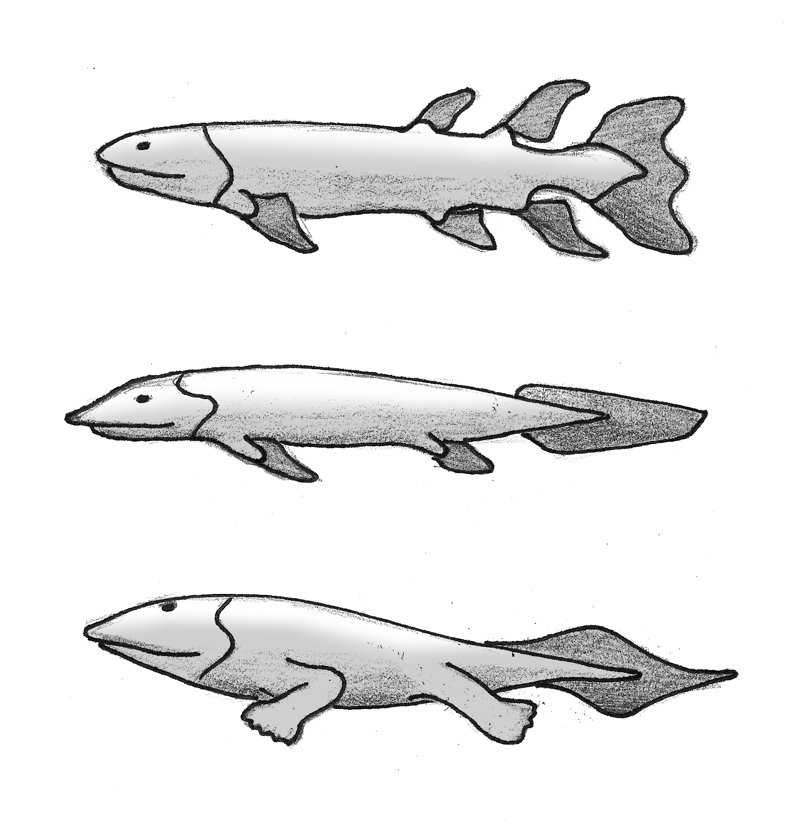
When a popular science outlet publishes a story with an artist rendition of an ancient creature which is based on a tooth fragment labeled as “primitive” or “primordial” the public just gets the story; when it lived, when it went extinct, what habits it may have had. You can do nothing more than choose to trust in the story teller. For all I know, the genetic code used to build an intricate component of a long gone complex creature composed of millions of cells could be every bit as sophisticated or even more so than our modern code. It's not necessarily primitive or less developed because it is old and dusty.
In general the public knows nothing about the genomes, but it is often described as evidence of evolution and creation depending on who you talk to. So people trust in different storytellers. Some say it contains loads of “junk”, which supposedly supports the story of evolution, or that it has the appearance of an elegant program supposedly consistent with the story of creation. Most of us know absolutely nothing. Does it show evidence of development over great ages? Does it show that we are related to mushrooms? Which geneticist are you going to trust?
"...we can also trace our history inside our genes, through DNA." [Shubin 2008]
We talk a whole lot about evidence. But its all really stories about people who came to different conclusions. Not presented with the evidence, one can only decide which story teller they will trust.
I have seen it so many times when I get into a deep conversation with someone about evidence, at the end of the day, they eventually fall back upon their trust. They may not have all the evidence, but others do. It has been “proven”. They were originally persuaded by reason, even though they do not remember all the reasons at present.
I kept hoping I would eventually find giant collections of complied data in some easily viewable format. I've suggested to educators and geologists that perhaps this sort of data be published for the general public. I have been told that such data is not published because their is no audience for it. People need to make money with books. And this is understandable. So they continue to publish illustrated story books. Real data is so difficult to find.
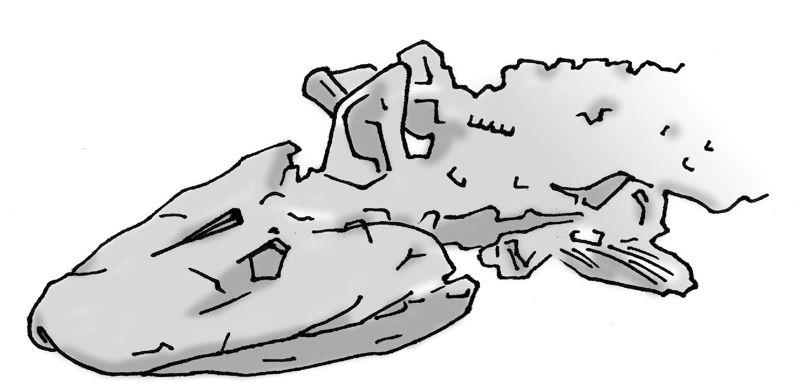
If you want real data, it's wrapped up in niche vocabulary, technical details, equations, complex graphs etc. To those with limited interest, resources, and time, the natural response is to trust whatever pronouncements come from the people who dwell in the apparently sophisticated field.
When you have made a commitment to trust one storyteller, you must necessarily distrust the opposing story tellers. So you accuse them of ignorance, contaminating samples, or maliciously twisting data. Who is picking the right elements to analyze? The creationists find a date consistent with their story by looking at carbon content in diamonds, or amount of helium in a rock. They accuse the evolutionists of looking at potassium and uranium which will confirm their story and ignoring others because of their prior commitment to their storie's timeline. And the same accusations and skepticism are on the other side. How are believers to know? Most believers don't know the ratios of any two elements, from a single spec of rock, from a single fossil site anywhere on earth.
Since it is because of trust that most people believe in one of the stories, it makes since that gaining trust is the primary tactic of both sides. If you pay attention it can be seen everywhere. Each side says look at all the people who believe this story.
A good example is a lecture I attended at a local college entitled “Why All the Fuss About Darwinism” with speaker Eugiene Scott, former Director of NCSE. The purpose was to discredit creation and support evolution. She mentioned a few subjective particularities like vertebrates having 4 limbs, and the same genes residing in both animals and fruit flies. Beyond that it was statistics and rhetoric to persuade that the establishment is to be trusted. I learned that the Pew Foundation reports that 97% of scientists believe in evolution. There is no controversy at the university level she said. Scientists don't know what all the fuss is about. Scientists don't have evidence against evolution. Scientific journals do not publish evidence against evolution. These professionals just scratch their heads when they see all the controversy in the K-12 schools. In their profession it is taught as a matter of fact. It is not an equal fight. In other words she is saying that even if these bits of evidence do not convince you, you should trust all these smart people who believe this story!
Believers in the creation story do the exact same thing. The Discovery Institute put together a list of 700 doctoral level scientists and engineers who are skeptical of the story of evolution5. In response to this, NCSE complied a list of over 1000 people with the first name “Steve” who do believe in evolution6. The goal for each side, is to become an authority figure which can earn peoples trust.
A child trusts completely in its parents. It is from them that they receive everything; food, shelter, security and words to describe the world. They trust completely, and they have no reason to not trust. They will trust without scrutiny even as they attempt to understand what it is your telling them.
If a child is told that an old man with a large white beard and a red coat visits every house in the world one night a year to deliver presents, they will believe it. When the whole world is new, why should you have any reason to not believe it is as they are describing it to you?
When we grow up, we become more critical about what we are told and who we trust. As experiences are accumulated in school, work, and play, through lots of interactions with lots of other people, we abandon belief in some of the fun stories we were taught as children. We do so because some things we were taught contradicts something else we have learned, observed, or experienced. After learning of the limitations of
a small soft human body, the great expanse of the earth, and the huge number of children spread over its face, many become suspicious of the Santa story, especially when they leave home!
The problem with origin stories is that there are no relevant experiences or knowledge, non-subjective evidence publicly available, or no corrective force to move people away from trust in false story tellers. Because particularities are not shared, and people are only left with the option to trust in a story or not. Most believers know next to nothing about the fossil record, rocks, or genetic code. So we continue with our natural tendency to trust and we will not be shown to the contrary. Both fight an endless war with meaningless rhetoric, subjective particularities and attempts to gain trust. People do not trust because of any pure logic or reason, it's just something we do naturally and without concrete reason and logic rooted in experience, inconsistency so.
SUMMARY
Why does conflict over origin stories exist? We have learned a great deal from our experiences in this world. Humans excel at manipulating things which they can sense with their eyes, hands, ears, tongue, and noise. That coupled with the use of language enables humans to work together with incredible results. Their power in this regard seems limitless. Their achievements like skyscrapers, satellites, rockets, and integrated circuits are evidence of their incredible power.
However when people start talking about the origin of the world they have stepped away from experience and their power is diminished. Some words exchanged are no longer colored by earthly experiences, so meaningful communication does not take place.
Logic and reason are no guide because they are only consistent when informed by consistent experiences. Since none have experienced the origin of the world, people believe contradictory stories and have different opinions of possible and impossible making conflict inevitable.
Most know very little about the particularities of the earth's rocks, fossils and genomes, because sharing them is not a priority. So they trust in people who talk about evidence instead. Trust in false story tellers is never corrected.
People have grown to feel so powerful and privileged as to believe that their every gut feeling, emotion and desire points them to truth. These self perceived powers, abilities, and privilege within the minds of individuals is the seed of much contradiction and conflict in our world.
Harmony
After years of considering the issue, it is no longer any wonder why people do not agree on any one origin story. But shouldn't they be able to get along? Why all the fighting in court rooms and on school boards over the governments support/prohibition of origin stories? Can't we compromise and find common ground?
The most simplistic and obvious resolution to the conflict is to make the government neutral to origin stories. Deal with both stories similarly. Don't teach either story in public school. Just teach about the present day world in science class. Do not supply public money for the purposes of adding chapters to either story.
Why not treat them the same? What are the differences between the two stories which permits people to discriminate between them?
Often times people justify different and unequal treatment of the two origin stories by assigning them different labels: "science" and "religion". The first amendment to the federal government's constitution states: "Congress shall make no law respecting an establishment of religion, or prohibiting the free exercise thereof..." This enables evolutionists to enforce and support their story and at the same time prohibit the opposing story by assigning labels.
One court room battle (Kitzmiller et al. v. Dover) was actually over the issue of labels; whether or not “intelligent design” could receive the label "science". But certain documents were obtained which convinced the judge that the subject must actually be labeled "religion" (disguised as "science").
Again language is a source of conflict because words are not well defined. What do these labels mean? Better yet, forget the labels, cut to the chase, what is the difference between the two stories to which they are assigned? Why should the story of evolution be blessed with victory and legal protection while the other is prohibited?
They have a lot in common. Both have to do with the origin of our world and life. Both stories have immense significance to different people; as evidenced by the passion of people involved in this conflict. They both effect perceived purpose of life; giving some a deeply cherished purpose, or to others an appreciated lack of purpose.
Many will consider a difference in the "cause" of each story. One story caused by god and the other caused by laws. But as discussed earlier, no distinction can be drawn between these using concrete worldly experiences, so it is effectively a meaningless distinction.7 There are differences in the events of the two stories, but how are any of them significant enough to discriminate so strongly against one? Can anyone really say that the US constitution amendment intends to say that it's: ok for the government to say the universe is old, but not ok to say it's young? Ok to say the universe came into existence suddenly (with a bang), but not ok to say that man came into existence suddenly? Ok to have the genome developed slowly, but not ok to have it fast? Ok to be related to other creatures, but not ok to be unrelated?
There is really only 1 reason anyone would object to treating the two origin stories similarly; one all important distinction; that's perceived truth.
People can't agree to disagree because we can't tolerate false. The idea of a compromise is not acceptable to anyone filled with confidence in their story. A false story should not be taught in public schools no matter how badly someone wants it!
It makes sense why the underdog seeks desperately to have the "science" label attached to it's story. Science is a word used to describe the process of discovering truth or a body of true knowledge relating to the natural world and occurrences within it. So it is often used simply as a synonym for truth.
We have our government impose many teachings on our youth in public schools. The truth must be taught. People will even feel a duty or responsibility to educate the ignorant.
We can't get along – or agree to disagree – because everyone is so unwaveringly confident in contradictory stories. To those who would disagree with treating the stories similarly – who disagree with keeping government neutral – I have some words. My arguments differ depending on whether or not confidence is based on trust or evidence.
BELIEF BASED ON TRUST
The majority of evolution believers have confidence simply because they trust other people. They perceive their story as "proven". They believe the story to be reliable since it is a product of science, which is self correcting and reliable. They feel secure trusting in the majority which has built the story on a gigantic amount of data.
Is trust a rational thing? Should one feel proud or silly for trusting what someone says if that knowledge or thing cannot be obtained without trust? Where is the line between being gullible and overly skeptical? Between those who will believe anything and those who believe nothing? We try to find a balance, and we use the people around us to gauge our position. Is it good to trust your spouse? It is generally considered a virtue, if they are faithful. But if unfaithful, than trust is considered a blindness and foolish ignorance. Whether or not trust is good, then, is dependent on another variable, the truth. And well, how do you know if its true, if you're just relying on another? We all trust in false things until experiences show to the contrary. But without knowledge of the particularities there is no hope for correction.
Yes the evolution story has been proven, but actually both stories have been proven and disproven. For something to become proven is really just a statement about the condition of ones mind. Proof of a story is some set of experiences, evidences, objects, ideas or things which are sufficient to cause confident belief in that story. You can find a multitude of books which “prove” creation, and others which “prove” evolution, because their contents have thoroughly convinced at the least their respective authors. Similarly some defendants have been know to be "proven" both innocent and guilty for the same criminal act by separate juries.8 In many cases "proven" along with the corresponding particularities or experiences (proof) have nothing to do with the truth.
Yes science is a reliable process which constantly sharpens our understanding of the natural world. It is why we small and soft creatures are the most powerful on the planet.
It is powerful when attempting to come up with explanations for present day occurrences. It involves testing, and observing, again and again. It is really just paying close attention to the way the world works; organized observation and curiosity. With its many benefits in all aspects of our lives, it's natural that we trust anything done under its name.
However attempting to see the past in the present is a very different process. You cannot test a story in the same way you test present day phenomena.
A "test" of an origin story can consist of nothing more than seeking to determine if new particularities seem consistent with previous interpretations. If we are going to consider this science then science is not the good and pure thing it once was, and both stories could just as well be called science because believers of both are able to reconcile new particularities with their beliefs. If science is simply the process by which someone becomes more convinced of something, and assimilates new information into their story, than the word's meaning is too broad and is no longer worthy of anyone's trust.
Lots of people become thoroughly convinced of ridiculous things. When we do this with a story about the past, there is no referent or thing against which we can actually compare our understanding.
What about the fact that the evolution story is so firmly established and built on mountains of data? Why not trust the majority? Over a thousand PhD level Steves say evolution is true.
Looking at the stories of human history there are lots of examples of large groups of people who believed silly things. With no solid experiences to keep people in line the imagination is capable of some wild things. The fact that it is believed by a lot of people is meaningless if none among them is able present non-subjective evidence, which coincidentally removes the need to trust in the first place.
What about the mountains of data? There are so many specialists who have very detailed knowledge of different particularities. Any one person could not expect to know all of it so one needs to trust in the scientific community as a whole.
When defending the evolution story, sometimes the sheer volume of written literature on the subject is shown. In court room battles large stacks of books are displayed for intimidation. The anticipated effect is to create trust in the collective
Look back again at what Darwin wrote:
"In considering the Origin of Species, it is quite conceivable that a naturalist, reflecting on the mutual affinities of organic beings, on their embryological relations, their geographical distribution, geological succession, and other such facts, might come to the conclusion that each species had not been independently created, but had descended, like varieties, from other species." [Darwin 2008] (Emphasis added)
This whole idea of seeing the past in the present is a process in the mind of an individual. A single mind, reflecting on the particularities of the living world, might come to a certain conclusion.
Well a mind can only "reflect" upon those particularities that it possesses. And the human process of reflecting is only done on an individual level. A large group of people cannot collectively reflect on a massive set of data. It matters not how vast the data is if it is distributed among thousands of disjointed minds or books. Since there is no group reflection, the in-cohesive sum is no greater in its interpretive power than any single mind.
There is no massive mountain of proof, but tons small sets of proof. That is, none have reflected upon the massive accumulation of knowledge, but many have reflected on widely diverse sets of knowledge and become convinced that theirs supports their story.
There is then no excuse for requiring trust and not allowing evidence to speak for itself. Trust should have no place here. If it is true, as claimed, that many people believe because of evidence, then there must be many small sets of data which can be shared.
Darwin's Origin of Species did little more than point towards particularities. He did not beg for trust in his interpretation. Why should an idea which is founded in evidence ever for a moment require some sort of justification like "trust in the process of science", or any sort of trust?
What I have found, whether the story is true or not, is that with their very specific focus, specialists must interpret in light of the framework provided to them. With their incredibly narrow specialty, they are in no way more qualified to determine anything as broad of scope as the origin of life. They were persuaded of the story in their youth with the very same common subjective evidences which most are exposed to, and in their work rely upon the framework built up over ages to understand their small area of investigation, and to craft new chapters in the overall story. Otherwise their subject would be of no significance in the origin of life. It's hard to see the forest for the trees. It's difficult to discern overall pattern from a mass of detail.
If the sum that a person is able to see is only a collection of many interpretations by people who used the story as a framework for their interpretation, this is a perfect opportunity to perpetuate a false story.
I find it detestable that a believer would impose their story on another with government action simply because they trust in certain people who told them a story. They are like the many throughout history who believed whatever the prevailing story was in a given community.
There are a lot of people who would not attribute their belief to trust, thinking it is based on evidence. But I think the great majority would, after being pressed to provide their evidence, ultimately make appeals to authority; appeals to others who are keepers of the evidence and interpreters of the world.
People who just trust in story tellers should concede this fact and allow others the ability to trust in what makes them happy. Trust should not be perceived as adequate reason to advocate for government imposed indoctrination. Conflict will never cease if both sides simply continue to beg the other to trust them.
BELIEF BASED ON EVIDENCE
On the other hand there are other believers who will maintain that their confidence is based on cold hard evidence.
If the story is so apparent in the particularities of the earth, why not just let public schools share those? Instead of telling students a story, show them the story. Show what the fossil record looks like. Let evidence speak for itself.
Knowledge of the present is what enables us to shape our world. Origin stories do not supply this power, but rather meaning and appreciation, and we can certainly leave it to people to embrace that meaning which brings them joy. Show them what the world looks like and how it works. That will give them the tools to be productive members of society. Let science discuss the world and how it works. This is a higher quality, more useful, education.
For those passionate about spreading their story, find better ways to organize and graphically communicate particularities to make them no longer subjective. Embrace the facts. Show people the big picture. Don't continue to do the same things that are being done now, telling a story with a tinny “supporting” factoid. If your audience is required to trust your interpretive power, you're doing it wrong.
Believers of both stories can work together to this same end. Cooperation building up better data to communicate with the public. Rather than continually writing new story chapters which require previous commitment to the overall story, collect and organize data. Work towards the goal of nonsubjective data set. If the rock record really says something, help it speak for itself, because begging for trust simply will not work.
Let's break from tired technique of trying to make believers by telling stories and gaining their trust.
What if the evidence just isn't enough? Maybe people need to be the told the story to make sense of the facts. Really? Am I asking to much? After 200 years since Darwin's first observations, has there not been enough time to collect the facts sufficient to convince everyone?
If the particularities which persuade them do not persuade another then perhaps they should ponder the implications. The meaning of the particularities is then, by definition, subjective.
If one cannot gather evidence in such a way that it can be consistently interpreted, then why would they be so sure in the power of human brains? Perhaps they think far to highly of their own reasoning and are not as powerful as they had thought. Why should all the others be, be default, wrong? This is arrogance, and its bad.
If the sum of our experiences determines our conclusions, then one must be lucky enough to have experienced to proper experiences. We have a tendency to believe our every gut feeling as gold. We should not all feel so special. Why should we have won the lottery with the correct set of life experiences? We should be tolerant of each other. We should recognize our shared humanity. Blood goes through all our veins, we are all fleshy creatures that die, we all have the same gray organ from which our consciousness proceeds.
I like to challenge people to look at their evidence. People always respond that they have been convinced throughly over time and they have since forgotten. Both sides say this same thing. Each feels privileged and sure enough to believe that, whatever it was that caused them to believe, it must have been correct.
How about we all try to have some humility; recognize the limitations of our experience, knowledge, reason and power. Let's not assume others to be dumb and inferior and not condemn them for not sharing our preferences, opinions, or objects of trust.
Arrogance produces conflict and pain. When people become proud, hurt, persecution, suffering and death can follow. History holds all kinds of extreme examples.
In order to have harmony, there must be humility and understanding. The fundamental belief of superiority is the root of much conflict and pain. If we can all step back and make some very basic observations and reflections, maybe we will think a little less of ourselves and be less critical of the many who oppose us.
Does it hurt society if everyone does not believe the same origin story? We should not be so arrogant as to think that everyone must think exactly as ourselves.
Obviously both stories cannot be true and ideally only the true story should be taught in the public education system. But in a country with different people and different beliefs in stories of times beyond our reach, compromise is the only way to get along. Treat the stories similarly.
If you trust, allow others the opportunity to feel secure in their trust as well. Don't let people fool themselves into thinking they believe because of evidence when it is merely trust.
If you know because of evidence, share it! Lots of people including myself would be glad to see it. But don't just tell more stories and beg for our trust. Let's be the rational, fact based, society that we pretend to be, not a culture of story tellers.
If religion is to be defined as beliefs which produce comfort and lend meaning and purpose to life, than origin stories are religion and both stories should be treated as such by the government. Evolution should be removed from its privileged position and be replaced with a more concrete, present day, education.
If evidence not sufficient to convince others, than consider the implications. Be humble. Without that there can be no harmony.
References
Crothers, Julie. “Public cash to teach creationism”. The Journal Gazette. 2 February 2014: 8A. Print.
Darwin, Charles, and Charles Kelchner. The Origin of Species. New York: Pocket Books, 2008. Print.
Doolan, Robert. "The fossils shout creation" Creation Ministries. n.d. Web. 1 August 2015. <http://creation.com/the-fossils-shout-creation>
Johnson, George B, and Gary J. Brusca. Biology, Visualizing Life. Austin, Tex: Holt, Rinehart and Winston, 1994. Print.
Lubenow, Marvin L. Bones of Contention: A Creationist Assessment of Human Fossils. Grand Rapids, Mich: Baker Books, 2004. Print.
Matsumura, Molleen, and Louise Mead. “Ten Major Court Cases about Evolution and Creationism” National Center for Science Education. 14 Feb 2001. Web. 1 August 2015. <http://ncse.com/taking-action/ten-major-court-casesevolution-creationism>
NABT. “NABT Position Statement on Teaching Evolution”. National Association of Biology Teachers. 2011. Web. 1 Aug 2015. <http://www.nabt.org/websites/institution/index.php? p=92>
Newport, Frank. In U.S., 46% Hold Creationist View of Human Origins. Gallup Politics. 1 June 2012. 22 Aug. 2013. <http://www.gallup.com/poll/155003/Hold-Creationist-ViewHuman-Origins.aspx>
Sanders, R. "Making Living Matter Programmable - Electronic Products." Electronic Products. 55.5 (2013). Print.
Shubin, Neil. Your Inner Fish: A Journey into the 3.5-BillionYear History of the Human Body. New York: Pantheon Books, 2008. Print.
Spetner, Lee. Not By Chance! Shattering the Modern Theory of Evolution. Brooklyn: The Judaica Press, 1998. Print.
Strobel, Lee. The Case for a Creator: A Journalist Investigates Scientific Evidence That Points Toward God. Grand Rapids, Mich: Zondervan, 2004. Print.
Thompson, Ida. The Audubon Society Field Guide to North American Fossils. New York: Knopf, 1982. Print.
Notes
- Obviously the word “god” is not completely void of meaning to many. The only way to give meaning to god is with worldly stories which people can relate to. Stories about people who heard a voice, or saw smoke and fire, or saw people rise from the dead. This, combined with many feelings and emotions gives meaning to the word. However this does not permit distinction from another word which has no meaning.
- I use the word “particularities” to be specific and distinct from “evidence” or “facts”. Evidence generally involves particularities, but in calling it evidence one is making a judgment in regard to its meaning. Likewise many often refer to am interpretation as a “fact”. Particularities are the specific, fine, descriptive details or appearance, shape, color and size of things in the present day world with no interpretation of their significance or meaning.
- These analogies come from books which teach the story of evolution.
- Common ancestry could be explained without genetic development through natural selection as described in the evolution story.
- http://www.dissentfromdarwin.org/
- http://ncse.com/taking-action/project-steve
- A survey shows that of the people who believe in evolution, 68% believe it was guided by God, while 32% believe God has no part. [Newport 2013] So the "god" cause is not even reserved to one story.
- http://www.nbcnews.com/news/investigations/trial-fire-junk-sciencesent-dad-prison-killing-wife-kids-n89601
First Edition, 2016 · ISBN 978-1537184562 · © Dan A. Wonderly II